 |
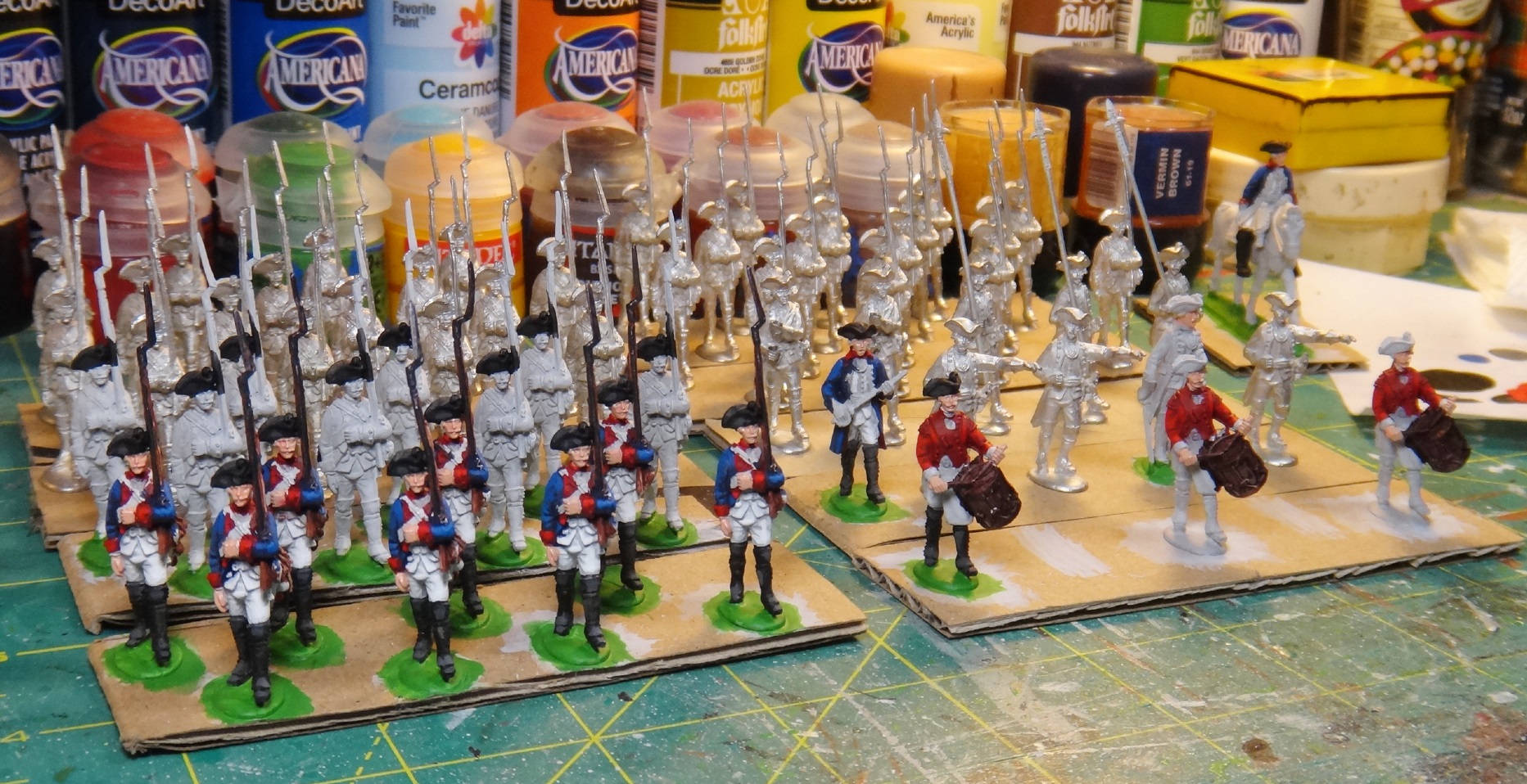
| Still far from anything close to finished, but shaping up in a not unpleasant way. |
Another couple of hours in the painting chair the last two evenings adding basic brown to the musket stocks and fur knapsacks on the left hip plus the dark silvery-gray 'Gunmetal' last night. The latter is quite a bit darker than the usual silver that I have used for musket barrels, firelocks, etc. in the past, but much more realistic based on surviving examples I've seen over the years in various museums on either side of the Atlantic.
Next up, basic shoulder belts, and then I think I'll bounce along to the next eight musketeers in the queue before final small detailing to bring the first company of 19 to the glossing stage. As a reminder, since the inception of the ongoing Grand Duchy of Stollen project way back in 2006, I have more or less followed the unit organization laid out in Charge! Or How to Play War Games (1967), which some small revisions for cavalry squadrons.
For line infantry, that means a company has 16 privates, a musician, NCO, and and officer on foot. A full regiment consists of three such companies along with a small color party and a mounted officer. Quite a bit of time and work to get units all done and based, but there is no denying the wonderful effect of several such units arrayed across the table.
Of course, as Greg Horne, the man behind The Duchy of Alzheim blog, noted a year or two ago, the footprint of units like this is quite large, but it works well for games featuring 6-12 units per side along with a few guns and crews. Greg's own large mid-18th century units of RSM95 figures that he was painting at the time were and remain a huge inspiration to me.
And there can be no denying that "the look of the thing" is of utmost importance when it comes to toy soldiers. But this seems to fly in the face of current small unit sensibilities where a lot of rule sets are concerned, however, but there we are.
I suppose in our era of everyone being perpetually and terminally "busy" -- Go on. Ask anyone how they are and see how they invariably answer. I began to notice this trend in the mid-90s. It has become the default response for many. -- small units work for many people.
Half a dozen figures may be used to represent full brigades in many rules now, but they don't strike me as very convincing if one is after columns, lines, squares, and sweeping cavalry charges across the table. In my own opinion, small numbers of figures lack the similarity to actual formations and are not as convincing.
But that's just me, and there is certainly room for different approaches to the hobby of wargaming and collecting toy soldiers. I certainly will not tip over a table full of scenery and miniatures in a huff because others take a different view and use different rules, organize their armies, or approach their hobby differently.
If we want the miniature wargaming hobby to move forward in a productive way and continue, then we should avoid bickering about differences and concentrate more on promoting the activity and having fun with it.
-- Stokes
Comments
Like you, I love to see a mass expanse of colour arranged in line and column, so I am very much looking forward to seeing these develop.
Marvin
Cheers,
David.
One thing is that players accustomed to 12 man battalions or similar tend to forget just how big and clumsy formations were, and the challenges of manouevring a long thin line to wheel or change direction. It would be a useful corrective for them to occasionally play formations at this kind of scale, just as a reminder when whizzing those dinky little units round the table.