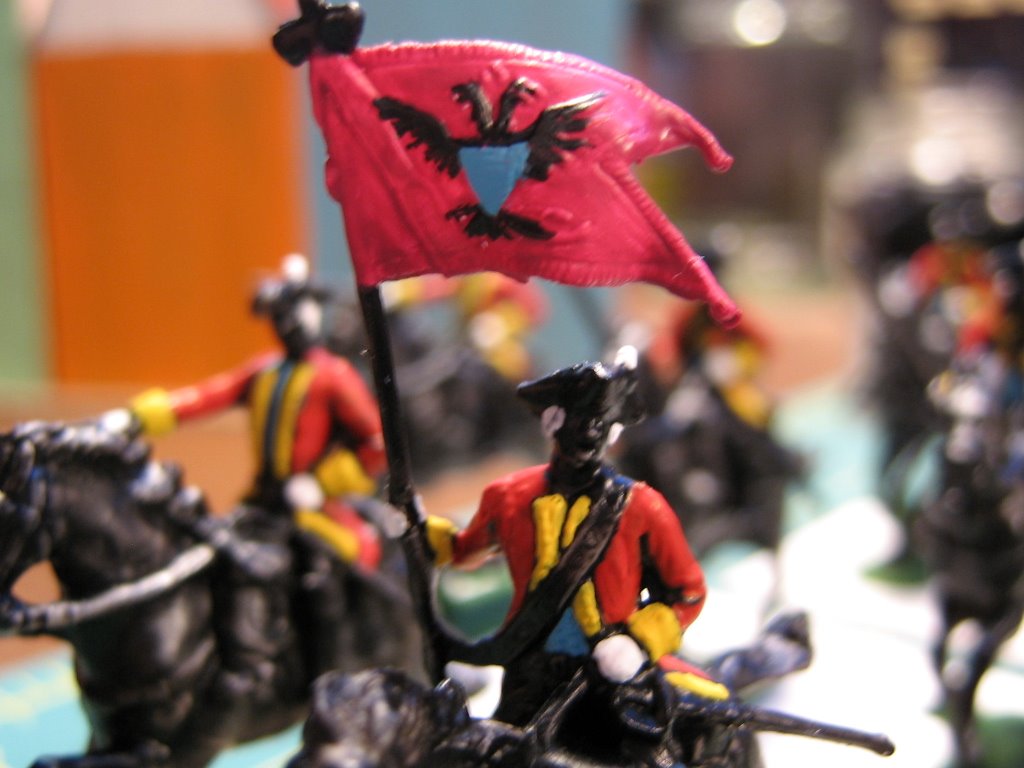
Macro Guidon Bearer

And here's an extreme close-up of the dragoons' guidon bearer. Do any of you know what the rank of a dragoon trooper, who carried the guidon, would have been in 18th century Germanic armies?

In keeping with my need for lovely, bright, showy colors, I decided to give the regiment a crimson/lavender (GW Warlock Purple) guidon with a black doule-headed eagle and a light blue coat of arms onto which I'll veeeeerrrrry carefully paint some tiny red and yellow bars. The Guidon itself will get some gold fringe outlined in black around its edge as the final painting step. So, still lots of work and a few touch-ups to complete, but you get the idea.

Comments

Anonymous said…
Not sure exactly about the Germanic cavalry 'guideon' bearer.

The 'porte-fannion' of the French, including prior to the revolution was a 'sous-' or under officer.

The Brits had a rank called 'ensign' that supposedly carried one of the regimental colors.

With the Cavalry, the 'officers' were often nobility, so perhaps the 'rank' of such a flag bearer might be the 2nd or 3rd son of a noble associated with the regiment of Cavalry.

Popular posts from this blog

And We're Off!!!

  Arrrgh!  Gotta go back into camera settings on my iPhone to bring all of the frame into focus.  Blast! Painting is underway on the 60 or so Minden Austrians, which are slated to become my version of the Anhalt-Zerbst Regiment of AWI renown.  More or less indistinguishable from Austrians of the era really, right down to the red facings and turnbacks, but the eventual flags (already in my files) will set them apart.   I went ahead and based-coated all of them over a couple of days lthe last week of August, using a mix of light gray and white acrylic gesso, before next applying my usual basic alkyd oil flesh tone to the faces and hands.  In a day or two, I'll hit that with Army Painter Flesh Wash to tone things down a bit and bring some definition to the faces and hands.   As usual, the plan is to focus on about 20 figures at a time, splitting the regiment roughly into thirds along with the color party and regimental staff.  Depending on ...

The 18th century? What's the Fascination?

Hessian musketeers by All the King's Men Toy Soldiers of Snellville, Georgia, U.S.A. Just a quick post post today, but I thought the above question might be interesting food for thought. Obviously, there is an array of possible periods, theaters, and conflicts that might catch our eyes. But what is it about the era 1700-1799 -- either real, or imagined? Is it the commanders and politics? The fairly straightforward tactics? The myriad of uniforms and flags? The variety and scope of the conflicts? The patchwork of various and sundry petty states, (at least in Central Europe)? I'm very interested to learn your thoughts. Don't be a lurker! Please leave a comment -- or even two or three. Have a nice day everyone!

Sunday Morning Coffee with AI. . .

    A rmed with a second cup of fresh, strong coffee, I messed around a bit this morning with artlist.io using its image to image function in an attempt to convert my hand-drawn map from September 2006 to something that more resembles an old map from the mid-18th century.  And just like my experiments with Ninja AI in June, the results are mixed.   The above map is pretty good, but Artlist keeps fouling up the place names and has trouble putting a faint overlay of hexes across the entire area.  Hexes, admittedly, are not likely to be found on any genuine maps from the era in question, but there we are.  Frankly, I prefer the appearance of the Ninja map, but there were problems getting it to correct its errors.  Grrrr.  As is the case with so much having to do with the various AI's out there now, the output generated is a direct result of the prompts entered.  For text alone, and when you develop a lengthy, highly detailed prompt, it is...